

New Space Science Application for the LV1 Microfluidiser
Please find below the latest news from our long-standing customer, Prof. Steve Armes from the University of Sheffield. His team has recently shared an exciting new space‑science application of the LV1 Microfluidiser, showcasing how this instrument—used in their laboratory for over a decade—has played a key role in developing synthetic cosmic dust particles for cutting‑edge astrophysics research. Their work highlights both the versatility of the LV1 and its growing impact far beyond traditional materials science a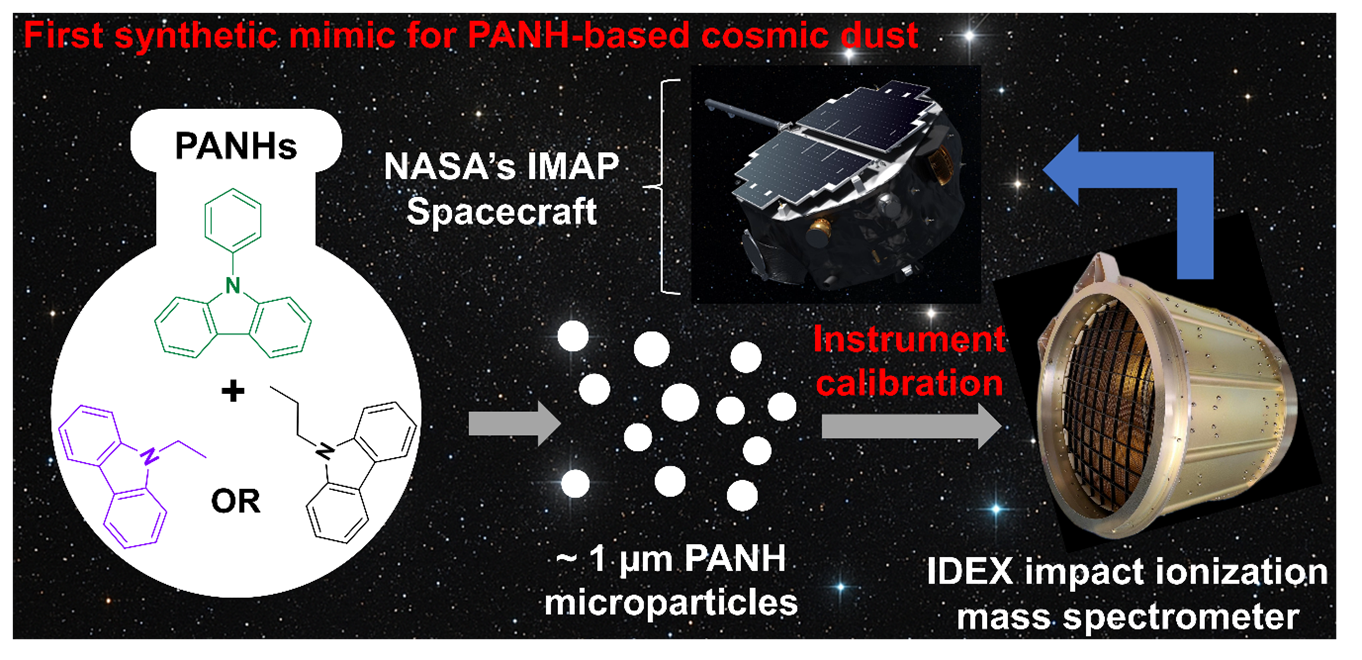 pplications.
“We purchased our LV1 microfluidiser more than ten years ago. We have typically used it to generate a series of Pickering nanoemulsions starting from much coarser Pickering emulsions prepared by high-shear homogenisation. We have produced oil-in-water, water-in-oil and oil-in-oil Pickering nanoemulsions stabilised using our bespoke block copolymer nanoparticles as part of industrially-funded research projects supported by DSM and Ashland. These studies have been published in Langmuir (8 papers) and the Journal of Colloid and Interface Science (1 paper).
Very recently, we have used the LV1 to design new synthetic mimics for cosmic dust particles as part of a Leverhulme Trust grant. More specifically, we have examined binary mixtures of N-substituted carbazoles, which are simple examples of nitrogen-based polycyclic aromatic hydrocarbons (PANHs) and have relatively low melting points. By working at the eutectic composition, N-phenylcarbazole can be processed with either N-ethylcarbazole or N-propylcarbazole via high-shear homogenisation to afford coarse molten hybrid droplets. Passing this hot emulsion through our LV1 microfluidiser at 55 °C produces much finer droplets of around 1 µm diameter. On cooling, hybrid microparticles are obtained that have a constant chemical composition. Once coated with an ultrathin overlayer of an electrically conductive polymer (polypyrrole), these PANH microparticles can acquire sufficient surface charge to enable their acceleration up to the hypervelocity regime (> 1 km s-1). Our collaborators at the University of Colorado use their $5 M state-of-the-art dust accelerator to fire such microparticles into a gold target. Such high-energy impacts generate an ionic plasma that can be analysed by mass spectrometry and serves as a characteristic ‘fingerprint’ for our original microparticles. Our joint study – which contains some rather unexpected findings – has just been published in a high-profile scientific journal (see M. Zeng et al., J. Am. Chem. Soc. 2026, 148, in press; https://pubs.acs.org/doi/10.1021/jacs.5c18079). Our long-term objective is the rigorous calibration of a cosmic dust detector known as IDEX that is deployed on the IMAP spacecraft, which is situated at a fixed point between the Earth and the Sun. These fundamental laboratory studies are essential for the reliable interpretation of mass spectra anticipated for the IDEX detector when it encounters interplanetary and interstellar organic dust particles over the next five years. So our LV1 microfluidiser is expected to play a vital role in refining our understanding of the chemical composition of our solar system.” Prof. Steve Armes from the University of Sheffield.
The graphical abstract for our new J. Am. Chem. Soc. paper is shown overleaf.
The image used for the IMAP spacecraft is the final frame taken from an animation of ‘IMAP Rotating Spacecraft’ (Animation Credit : NASA/Princeton/Patrick McPike)
Public Resources – IMAP Outreach
Read the full application paper here.